



January opened with a tentative sense of stability as markets absorbed 2025’s recurring volatility.
That stability did not last. In February, war in the Middle East unsettled markets again, continuing a long pattern of energy-linked conflict in the region.
Commentary abounds on market effects – especially oil price spikes and inflation. Fewer analyses emphasize a longer-run implication: energy transition as national security policy that reduces exposure to recurring shocks.
A historical reference point is instructive. In 1953, the CIA and MI6 supported a coup that removed Iran’s elected government, in part to secure oil access. The episode underscores a broader point: energy dependence has repeatedly entangled Western policy in regional instability.
This raises a simple question: to what extent can domestic energy investment reduce exposure to unstable suppliers? Framed this way, the energy transition is not only environmental policy, but also a strategy for economic resilience and improved energy and national security.
Climate benefits then become a byproduct of policies motivated by security and economic concerns.
Sqeaky Wheels and Oil
The United States is a net exporter of oil and gas. Even so, petroleum imports still account for roughly one-third of its ~$900 billion trade deficit. There is broad agreement this is undesirable; paired with sharp disagreement about fixing it.
Energy policy remains inseparable from politics.
Is it Possible to Reduce Oil Dependence?
History suggests it is.
After the 1970s oil shocks, France pursued aggressive nuclear expansion under the Messmer Plan. Although it fell short of “tout electric / tout nucliaire” ambitions, France reduced petroleum imports by roughly 70%. In the process, France gained:
- Improved trade balance
- Lower, more stable electricity prices
- Greater industrial production and export capacity
- Increased energy security
- Reduced exposure to energy-related shocks
Today, French households pay 80% less for electricity than those in Germany, reflecting differences in generation mix.
Domestic Versus Imported Energy
Let’s look at three examples from different timeframes: Iceland, China, and Pakistan.
Iceland provides a durable case: geothermal energy has displaced fossil imports and is associated with annualized GDP gains of about 2.6%.
With top-down policy implemented in the past decade plus, China reduced reliance on imported energy while expanding electrification and domestic generation.
Two effects follow:
- Lower import dependence reduces exposure to external price shocks.
- Domestic clean-energy industries scale, supporting exports of EVs, solar panels, and wind equipment.
Most recently, Russia’s 2022 invasion of Ukraine drove LNG shortages that sparked a solar boom in Pakistan. Energy demand has risen in Pakistan, but fossil import costs have fallen by nearly 50%, saving an estimated $12 billion annually.
Of Government and Markets
The economic and security benefits are tied to the time horizon. Fossil fuels are relatively low-capex but high-opex; many alternatives reverse that structure.
Industry focuses on short-term paybacks, which often leads to policies favoring the status quo. Governments, however, should leave quarterly dividends to Wall Street, and focus on time horizons that better match the interests of its citizenry.
Advocates should bring facts like these to force that longer-term discussion. Energy transitions are often framed ideologically as “state versus market.”
This framing is incomplete. Many core technologies—including energy systems—have depended on public funding at early stages. Who thinks their iPhone was created entirely by private sector resources? Think again:
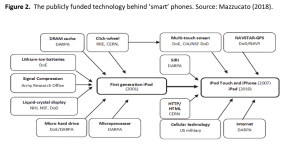
The relevant question is which forms of intervention best accelerate scalable technologies.
A Thought Experiment
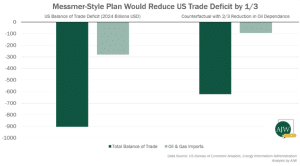
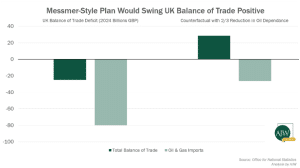
Suppose the U.S. or U.K. reduced petroleum imports by two-thirds.
In the U.S., the trade deficit could shrink by a large fraction – potentially more than 40% – depending on substitution and manufacturing strategies. It would certainly reduce external energy spending and increase domestic investment in energy technologies.
In the U.K., a similar reduction could potentially eliminate the trade deficit and move it into surplus.
These are order-of-magnitude illustrations – but fairly compelling.
Never Waste a Good Crisis
Geopolitical shocks are rarely one-dimensional. They impose costs but also accelerate structural change.
Energy shocks, in particular, speed substitution: when prices rise, previously marginal technologies become viable.
Climate outcomes often follow these shifts, though they are not always the primary driver. In periods of high prices, cost and security typically dominate long-term environmental preferences.
Still, objectives can align. The IEA’s net-zero scenario assumes wind and solar could reach ~70% of global electricity by 2050, up from under 10% today, requiring sustained multi-decade expansion.
Historical precedent suggests scale is possible. France’s nuclear buildout remains a commonly cited example.
The Closing Calm
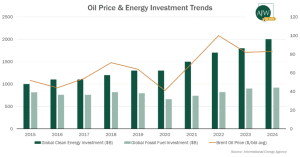
Investment in clean energy has risen, driven partly by sustained fossil fuel prices, despite political and geopolitical volatility.
Past oil shocks have repeatedly triggered structural energy change, notably in the 1970s.
If the current conflict raises prices further, similar opportunities may follow. Framing energy transition in terms of resilience and security is likely to broaden support beyond purely environmental arguments.
A more stable energy system can therefore serve multiple goals at once: security, growth, and environmental performance.
Oil has been material in western politics and Middle East violence for coming on a century. This time, perhaps, more good than ill can follow a conflict.
Hey, optimism is our bag.
AJW Quarterly Series: Finding Calm in the Chaos
A quarterly review of global forces across the energy transition, seeking the signal amidst the noise.
AJW is wading into the conversation because we see the upside in discerning the difference between caution and fear. We make no claim to clairvoyance – merely some hard-won insights, drawn from setbacks as well as successes during decades of working with dedicated and resilient energy leaders. We aim to help those seeking resilience, not retreat.
To learn more about our work – and to gain an experienced partner tested in the crucible of energy transition turbulence – visit https://ajw-inc.com/.
- 2025 Q1 Note: https://www.linkedin.com/newsletters/ajw-finding-calm-in-chaos-7316149438077440001/
- 2025 Q2 Note: https://www.linkedin.com/pulse/quite-quarter-wasnt-chris-hessler-4nfxe
- 2025 Q3 Note: https://www.linkedin.com/pulse/q3-transportation-transition-chris-hessler-xnn7e
- 2025 Q4 Note: https://www.linkedin.com/pulse/q4-2025-wrap-up-chris-hessler-x4xre